


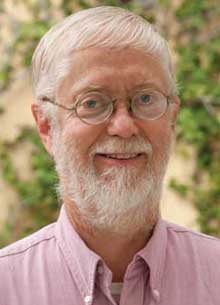
Bill Gessner likes working with people, and most of the time, you’ll find him wherever groups are creating plans for the future. Throughout his career, Bill has worked with hundreds of food co-ops and many development organizations. It is not an exaggeration to say that his ability to work with diverse groups of people has helped the food co-op sector grow and thrive. He has been a part of the decision-making processes of the organizations that have had a profound impact on how we do business.
It is not at all a surprise to most of us that Bill will be inducted into the Cooperative Hall of Fame on May 2 this year in Washington, DC. For Bill himself, it is a great honor, but he’s not especially comfortable in the spotlight. He’s one of the most unassuming people you’ll ever meet, preferring to blend into the crowd. “I can easily think of a few hundred food co-op leaders that should be honored well ahead of me,” he said. That’s what makes it especially sweet that he will be recognized for his contribution. The guy never takes the credit.
It’s also part of why he’s an especially masterful leader. Bill never sets himself up as The Expert. He guides people. By sharing information and technique, groups are empowered to do their own planning and development. In this way he is truly a cooperative leader, wherein the people he works with are the architects of the decisions they make. This doesn’t mean he’s laid back; absolutely not. He can be downright dogged. Bill will never give up. Never. Even if you call him at the eleventh hour and your co-op is on the brink of closing. In all his work with food co-ops, he’s “only lost one” as he put it. He’s been a backbone for those who need the support, and the X factor in so many organizations’ success. It’s this unique source of strength that our food co-ops have benefited from.
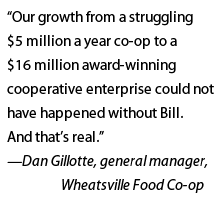 Like a lot of people who achieve greatness, who he is was shaped by formative experiences when he was young. Bill grew up an only child in Minot, North Dakota, and he recollects “wanting to be anywhere but there.” North Dakota to his mind was remote and isolated, and he longed for new experiences. Even though he felt that way at the time, he now believes that it was a great place to grow up.
His leadership skills developed early in his teens, and he was both the class and student council president of his high school. He was also the vice president of North Dakota’s student council. “It was my first experience working with groups,” he said, and as part of his involvement he went to conferences and met new people. He was also the student manager of his school’s basketball team, and that year the team won the state championship. (Bill will never brag, but he does still feel a sense of satisfaction that he could beat every single one of the team’s players at HORSE.)
Bill was also exposed to the realities of retail when he worked in his father’s paint and glass business during high school. Bill set up a separate picture framing department, making frames and taking orders. It did very well. Bill went to college at the University of North Dakota, and received a B.A. degree in 1969, majoring in philosophy. While he was there, he worked at YMCA camps in North Dakota and Minnesota where he was a program director, and where he had the opportunity to learn even more about group process. He furthered his studies by going to graduate school at the University of Cincinnati in an interdisciplinary philosophy program, where he studied under Margaret Mead. During those years he found himself tiring of academia, and having a growing interest in organic food, agriculture, and the entire food chain. When he left graduate school, he looked to the land for what would come next.
 Bill’s first employment with cooperatives occurred in 1974 when he was hired as a milk tester by the Filmore County Dairy Herd Improvement Association, a cooperative association of dairy farmers in southeast Minnesota. As part of the job he went to 25 farms, each one once a month during morning and evening milking to sample the milk of each cow. Not only did it expose him to farm life, but he got to know the families of the co-op members. He was often invited to breakfast and dinner after the milking. “It was a beautiful thing, and I loved it,” he said. Concurrent with that work, Bill decided to operate a maple syrup farm—after years of apprenticing—but had to give it up for health reasons.
Bill was born with a hereditary bone disease. He’d endured numerous surgeries while he was a child, and as a young man in his twenties, battled a malignant bone growth that threatened to take his life. As part of the healing process he was in a body cast for six months. This is something Bill seldom talks about. It’s not a secret, but he said he never wanted to be defined by illness, preferring instead to focus on other things. Of course, the bout with cancer was life-changing. He became interested in health and healing and in 1975 became a vegetarian. “The whole experience very much shaped my approach to life,” he said. The experience strengthened his powerful resolve to never give up. It’s why Bill can be optimistic in the face of major challenges and be a positive force for others. He’s been there. He knows exactly what it feels like to wonder what’s next and what’s possible.
Bill moved back to North Dakota during his recovery, and became involved with the Grand Forks Food Co-op (now called Amazing Grains) becoming a coordinator/manager there in 1976, which meant “helping with whatever needed to be done.” He organized his first co-op expansion/relocation in 1978, leading the co-op to a new and expanded location. During that time he met Dave Gutknecht, a guest speaker at a Common Health Warehouse membership meeting, and was inspired by Dave’s vision and commitment. Bill also met Dean Zimmerman, a fellow North Dakotan living in the Twin Cities. “I enjoyed him a lot. He had a missionary zeal to him when he would come back to visit in North Dakota,” Bill said. It was through Zimmerman he learned more about the All Co-op Assembly, the Midwest region’s food co-op resource group at the time, as well as the Twin Cities food co-op scene.
At an All Co-op Assembly gathering, Bill met a guy standing at the back of the room during a meeting who “nodded at me and said ‘these people are going to need a lot of help.’” He never learned the guy’s name, but what he said was like a prescient visitation from the future.
In 1979 Bill moved to Minneapolis, where he currently lives, and took a bookkeeping job with Roots & Fruits Cooperative Produce, a collectively managed, worker-owned produce warehouse. Bill’s career in food co-ops gained expediency and propulsion in the 1980s. He led Roots & Fruits to switch to a general manager structure, and then managed it for three years. In 1987 he began to take on expansion consulting projects through Northcountry Development Services. Soon enough he had more work than he could handle. In 1991 he founded the food co-op consulting group through Co-op Development Services (CDS), later adding Paul Cultrera, Marilyn Scholl, Scott Beers and Walden Swanson (another Co-op Hall of Fame inductee). In 2008, the group had grown to 20 consultants and became independent, incorporating as a co-op now called the CDS Consulting Co-op.
Bill is best known for his work with food co-op expansions and relocation projects, and by his estimate has participated in close to 300 successful projects. What Bill may be under appreciated for is that he has also played a leadership role in some of the food co-op sector’s most strategic decisions over the last few decades. For example, his role in helping found the Cooperative Grocers Association Midwest (the first food co-op grocers association) in the early 1990s, led to the creation and growth of the National Cooperative Grocers Association, a secondary co-op supporting and promoting food co-ops around the country as a virtual chain. (He also played a key role in the creation and reorganization ofNCGA (in 1999 and 2004 respectively), the creation of CGIN(Cooperative Grocers Information Network), and he was an instructor in the Cooperative Management Institute (CMI).)
 When he looks back on his career, Bill said that the cooperative idea took hold early on, and when he became seriously involved, “I never thought of doing something other than working with co-ops.” Bill explained his commitment to co-ops springs from a vision for a human-scale approach to business, one that recognizes a balance of vision and values to best-practices. “I’ve been drawn to the distinction and synthesis of business development and organizational development as an approach to cooperative development. Recognizing and working with the duality and the blending of those two aspects—the business and the cooperative—and bringing them together in ways that strengthen each part is compelling to me.” Like an alchemist, Bill can take two seemingly unrelated concepts and combine them to make something remarkable.
Bill also has two equally interesting and unique passions in addition to his work with co-ops, and these things keep a bounce in his step. Literally.
Bill is an avid tennis player, playing daily, year in, year out. If he is traveling to visit your co-op, you will be invited to play. For many cooperators, a tennis game with Bill is a highlight of their connection to him. Before each game he reviews his goals: No one gets hurt. Have fun. Strive for continuous improvement. Get the ball over the net.
Bill is also a songwriter, singer, and musician, and has equally deep roots in the folk music community. He has two recordings of original songs: Welcome to Gessnerville, Population 19 (2001, produced by Peter Ostroushko, who also plays mandolin and fiddle on a number of the songs), and Wild Life in Gessnerville, Population 20 (2009, produced by Kenny Edwards). Both CDs feature an all-star cast of musicians.
No matter what he’s engaged in, it’s about being with people, and creating something together.
Jimmie Dale Gilmore summed it up best when he said about Bill’s first CD, “The songs of Bill Gessner reaffirm my belief that an observant mind, an open heart, a sense of humor and a gentle spirit remain the cornerstones and foundation of good songwriting.” Just change “songs” to “work” and “good songwriting” to “cooperation” and there we have it.
Welcome to the Hall of Fame, Bill.
_________________________________
See what more cooperators have to say about Bill:
- Alysen Land, Ozark Natural Foods
- Annie Donovan, NCB Capital Impact
- Robynn Shrader, National Cooperative Grocers Association
- Kevin Edberg, Cooperative Development Services
- Stuart Reid, Food Co-op Initiative
- Marilyn Scholl, CDS Consulting Co-op
- Jeanie Wells, CDS Consulting Co-op
Have more questions?
Get in touch with one of our consultants.